
Helmets protect riders on every ride. However, they also trap sweat, bacteria, and odors over time. The inner part gets all the perspiration and heat, so it becomes a cozy place for microbes between rides when riders aren’t there to change them. Wiping the outside or using a scented freshener won’t remove the germs and viruses hiding in the foam and straps. And that was where UV-C technology in helmets brought about a big change in the way riders clean their gear. It works without any chemicals or heat by damaging the DNA of microorganisms through germicidal light.
Throughout this article, you’re going to learn what UV-C is, how UV-C Technology in Helmet Disinfection helps, and also why GlowMe Smart is introducing automated, powered UV-C machines to riders all around India.
What Is UV-C Technology?
What’s UV, C Technology? UV-C technology uses ultraviolet light with short wavelengths. It ranges from 200 to 280 nanometers on the electromagnetic spectrum. Unlike visible light that we see, UV rays are the kind of light that you can’t see. These photons have high energy. When they touch germs or viruses, they can change the DNA. This change stops the organism from replicating. It can be used to disinfect surfaces, air, water, and other media to destroy germs.
Fundamentals of UV-C Sterilization in Helmet Cleaning
Helmets can raise hygiene issues quite differently. The headband of a helmet collects sweat and body heat, making a warm and damp habitat where bacteria and fungi reproduce very well.
The hard part and straps accumulate dust and other impurities. Only wiping the surface would fail to reach the bacteria living inside the foam.
How to UV-C Sterilize Helmets? Below are the Fundamentals of UV-C Sterilization in Helmet Cleaning:
- Physical exposures: For example, the microorganism must be exposed to ultraviolet light. Sanitization devices use light sources. These lights evenly shine on the inner layer, the rigid section, and the straps.
- Dose and exposure time: Efficiency is measured by light intensity as well as time of illumination. A longer or more light-intense cycle yields a higher dose, which can ensure full sterilization.
- Chemical residues are absent: Versus sprays, UV-C doesn’t leave anything behind- no residue, no smell, and no irritation risk for the next user.
Adopting these principles will turn helmet cleaning into an effective way to kill bacteria, not just mask the issue.
How UV-C Technology Work in a Helmet Cleaning Machine?
The steps inside a helmet cleaning machine are simple, automated, and designed for consistency. Here’s a complete process of how UV-C Technology works in a helmet cleaning machine.
- Step 1 — Helmet placement: Each helmet is placed inside the disinfection chamber by the motorcycle operator. The machine holds the helmet to ensure UV-C light hits all surfaces. This includes the liner, shell, and straps. Every area needs cleaning.
- Step 2 — UV-C exposure: A chamber is flooded with germicidal light when the UV-C lamps activate. The light penetrates the liner, shell, and straps to disrupt the DNA of pathogens on contact. This cleaning period continues for a fixed duration that depends on the intensity of the lamp.
- Step 3 — Additional sterilisation layers: UV-C is paired with ozone treatment and steam in many modern machines. Some believe ozone can fill small gaps that light can’t reach. At the same time, steam offers thermal disinfection. These methods create a multi-barrier approach that ensures that no pathogen remains untouched.
- Step 4 — Drying and cooling: Residual moisture is removed by a 360-degree warm air drying cycle after the sterilisation finishes. It has been observed that moisture encourages the regrowth of pathogens. A dry helmet remains a clean helmet, which is ready for the next ride.
This entire operation is kept touch-free and operator-independent. Hence, the machine runs the same way during every cycle because consistency is required for safety.
Benefits of UV-C Technology in Helmet Disinfection
The Benefits of UV-C Technology in helmet disinfection are numerous, as UV-C technology is the most effective option for keeping helmets clean. It works well for both personal and commercial use.
Chemical-free cleaning occurs when UV-C technology utilizes light to eliminate harmful microorganisms. Many people believe that no poisonous residue or skin irritation occurs when this method is used because light is a natural force.
- Fast and efficient: Time is saved because a standard cycle finishes in a few minutes. This process is fast, and UV-C Technology is useful for daily tasks at gas stations or leasing centers.
- Broad-spectrum efficacy: Germs like bacteria, viruses, and fungi are stopped at the genetic level by UV-C Technology. These harmful microorganisms can’t multiply because light energy breaks their internal structure.
- Safe for helmet materials: UV-C Technology protects foam and fabrics in headgear. While liquid chemicals can harm soft parts, UV-C Technology does not damage materials or change their color.
- Odour elimination: Bad smells are removed by light during the cleaning process. UV-C Technology keeps headgear fresh by killing odor-causing bacteria. This means no need for fragrances that just mask smells.
- Automated consistency: Consistent results are delivered by automated devices in every cycle. It has been observed that because the same amount of light is used every time, mistakes from humans are removed, and the equipment receives a high level of cleaning.
- Reduced cross-contamination: The spread of sickness is lowered in places where headgear is shared by many people. UV-C Technology stops the spread of germs between different individuals because the transmission chain is broken through the destruction of pathogens.
For fleet operators, these benefits mean safer riders and a cleaner shared-helmet program.
Automated Helmet Disinfection Machines in India
Millions of two-wheeler operators live in India, where the use of shared helmets in rental groups is frequent. As people become more aware of hygiene, the need for reliable disinfection systems has grown significantly. Many people believe that clean equipment is now very important for every person.
Automated Helmet Disinfection Machines in India are now appearing in:
- Fueling centers and highway rest locations, where helmets are sanitized by two-wheeler operators during a short break for fuel.
- Motorbike rental centers and vehicle trade shops share helmets among different users all day.
- Shopping center vehicle areas and business locations that give priority to the safety of the individual.
- Physical fitness centers and athletic areas where helmets are used by individuals.
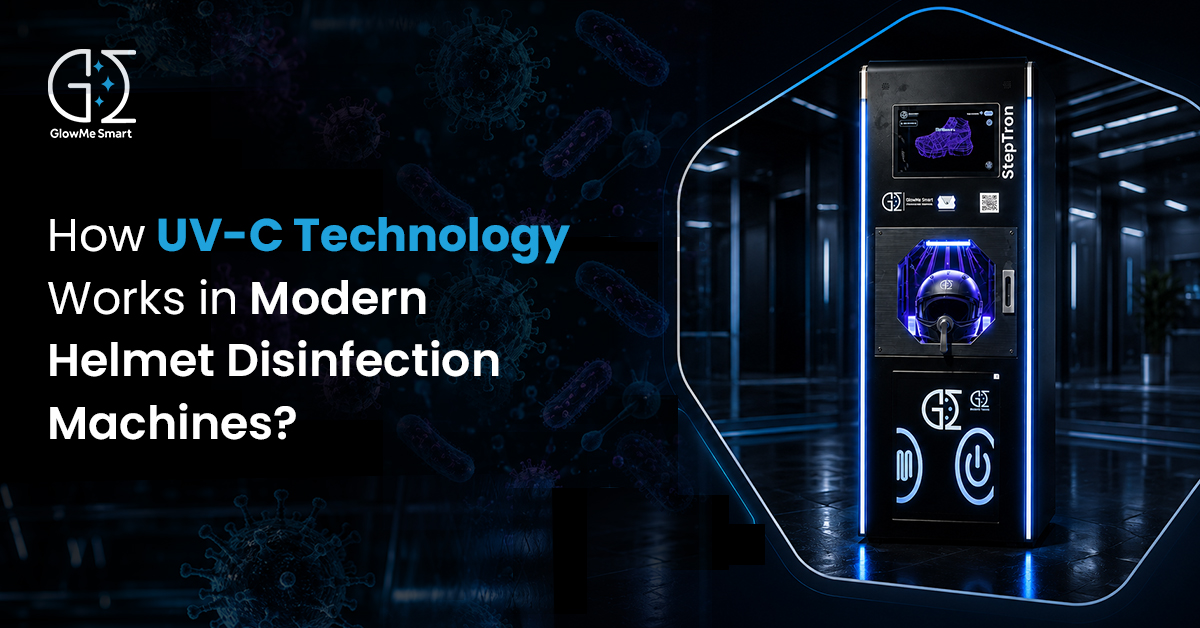
Helmet Disinfection Machines are very effective. They combine UV-C, ozone, and steam in one cycle. This method tackles bacteria, viruses, odors, and moisture all at once. For these environments, GlowMe Smart builds the HelmeTron kiosk. The HelmeTron kiosk uses a multi-stage cycle. It includes UV-C, ozone, vaporized disinfectant steam, and 360-degree drying.
This HelmeTron kiosk comes in single, dual, or ComboTron configurations. Only a regular power connection is needed for the HelmeTron kiosk, which means no plumbing or civil work is required. CE certification has been granted to the HelmeTron kiosk. However, this technology provides high safety for all users.
Why Should Riders Choose GlowMe Smart for Helmet Disinfection?
For years, many people overlooked helmet hygiene. But keeping equipment clean is crucial for safety. Using UV-C technology for helmet disinfection offers high-level cleaning for everyday riders. Because the health of the user is significant, GlowMe Smart provides this security for people through the HelmeTron kiosk. This specific system includes the use of UV-C, ozone, steam, and full drying in a single mechanical process.
High-level sterilization is achieved by UV-C technology during this cycle to ensure the equipment is safe. Many see safety as just physical impact. However, helmet hygiene is also important. It helps protect your body by removing bacteria. A clean helmet protects the physical condition of the rider while the person is traveling.
Reach out to GlowMe Smart today and give riders cleaner, safer helmets on every journey.
FAQs
1. Is UV-C safe for helmet liners and shells?
Yes. UV-C does not corrode or discolour helmet materials when used as directed. Unlike chemical disinfectants that degrade foam and fabrics, UV-C leaves no residue and does not break down helmet components.
2. How long does a UV-C helmet disinfection cycle take?
Most cycles complete in a few minutes, depending on the machine and lamp intensity. GlowMe Smart’s HelmeTron runs a full multi-stage cycle — UV-C, ozone, steam, and drying — in one automated session.
3. Can UV-C reach bacteria inside the helmet padding?
UV-C works on surfaces it directly reaches. Modern machines pair UV-C with ozone, which penetrates fibres and padding where light cannot reach, creating a multi-barrier approach.
