
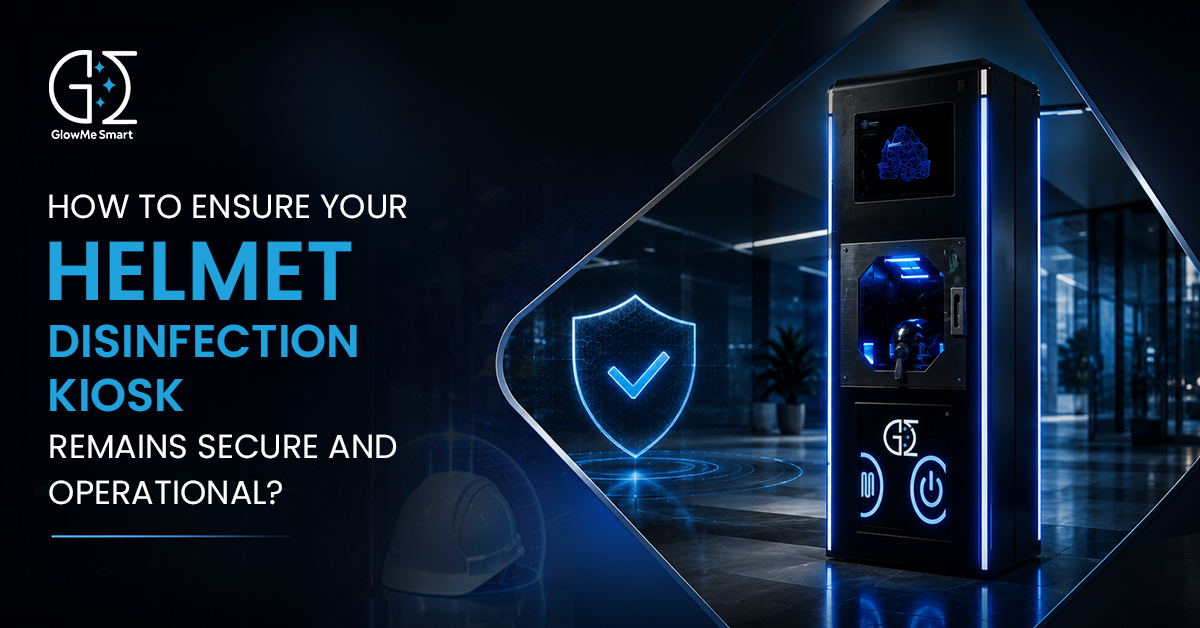
Helmet disinfection kiosk maintenance is the key to keeping a rider-facing hygiene system trustworthy even after installation. From the outside, a kiosk may appear to be good, but the UV-C output, atomisation nozzles, drying airflow, door locks, payment modules, and refill levels all require regular attention. As a Helmet Disinfection Kiosk Solutions Company in India, GlowMe Smart focuses on helmet hygiene infrastructure that is safe, trackable, dry, and reliable for petrol stations, fleet hubs, dealerships, parking facilities, and corporate campuses. A helmet kiosk is not only a machine put in a corner. It also acts as a hygiene asset for public use. When it is not working, is poorly maintained, or uses the wrong liquid, it damages the user experience rather than protecting it.
What Is Helmet Disinfection Kiosk Maintenance?
Maintenance of the helmet disinfection kiosk refers to the regular inspection cleaning, servicing, and replacement that are done to ensure the kiosk is safe and effective. It can be a chamber, UV-C lamp, ozone module, steam system, atomisation nozzle, drying system, door hardware, refill supply, software, and payment components. The aim is straightforward: a perfect start for each cycle, a safe run, a proper drying, and a finish without user confusion.
Why Does a Helmet Sanitizer Machine Need Regular Maintenance?
A helmet sanitizer machine works under a daily load. Petrol station riders, fleet workers, delivery partners, staff, and visitors may use the same kiosk repeatedly throughout the day. That usage creates wear on components even when the machine still appears functional.
Practical Helmet sanitizer machine maintenance tips begin with understanding what wears out first:
- UV-C output: Lamp intensity can be reduced before the lamp visually stops working.
- Nozzle performance: Residue or blockage can affect mist distribution inside the chamber.
- Drying airflow: Dust accumulation can reduce warm air movement and drying quality.
- Door hardware: Constant opening, locking, and sealing creates mechanical wear over time.
- Payment module: High public usage can affect touchscreen, scanner, or transaction response.
What Issues Most Affect Helmet Kiosk Performance?
The most common kiosk problems are not always dramatic failures. Many begin as small performance drops that facility teams notice only after riders complain.
A helmet may return slightly damp. A cycle may take longer. A door may need repeated attempts. A payment screen may lag. A refill warning may be ignored until the kiosk stops accepting cycles.
Common performance risks include:
- Weak disinfection stage: UV-C, ozone, or steam underperformance can reduce cycle reliability.
- Uneven mist coverage: A clogged nozzle may leave parts of the liner insufficiently treated.
- Poor drying result: Reduced airflow can cause helmets to be damp and uncomfortable for riders.
- User access issues: Door, latch, screen, or payment errors can stop completed cycles.
- Missed refill alerts: Low PureLine levels can interrupt usage during peak business hours.
Checklist for Helmet Disinfection Kiosk Maintenance
A structured Checklist for helmet disinfection kiosk helps operators avoid downtime and keep service standards consistent.
|
Maintenance Area |
What to Check |
Why It Matters |
|
UV-C Lamp |
Output, cleanliness, replacement schedule |
Maintains cycle performance |
|
PureLine Refill |
Level, compatibility, supply schedule |
Prevention of the cycle interruption |
|
Atomisation Nozzle |
Mist pattern, clogging, residue |
Supports internal coverage |
|
Drying System |
Airflow, vents, heat balance |
Keeps helmets dry |
|
Door Lock |
Seal, latch, sensor response |
Protects safe operation |
|
Payment Module |
UPI, card, screen response |
Prevents revenue loss |
|
IoT Dashboard |
Usage logs, alerts, and uptime |
Supports remote monitoring |
|
Chamber Interior |
Dust, residue, item debris |
Maintains user confidence |
|
Warning Labels |
Visibility, damage, placement |
Improves public safety |
|
Service Schedule |
Upcoming inspections, parts |
Reduces surprise downtime |
Best Practices for Maintaining UV Disinfection Kiosks
The Best practices for maintaining UV disinfection kiosks start with safety. UV-C systems should always work inside a controlled chamber, with direct exposure prevented by design and service panels handled only by trained personnel.
Operators should never treat UV-C lamps as ordinary bulbs. Output, placement, chamber condition, and replacement schedule all matter.
Best practices include:
- Follow manufacturer guidance: Service timing should match kiosk model, usage, and component life.
- Keep chamber surfaces clear: Dust, stickers, debris, or stains may affect light distribution.
- Inspect lamp condition: A glowing lamp may still produce reduced germicidal output.
- Avoid unauthorized repairs: Incorrect parts may affect safety, coverage, and service terms.
- Check cycle completion: Users should receive clear signals before removing the helmet.
How Do You Keep a Helmet Disinfection Kiosk Secure?
Security is both physical and operational. A public kiosk needs stable placement, controlled access, safe user instructions, and protected internal components.
Place the kiosk where staff can observe general activity without managing every use. Keep the floor level, avoid blocked vents, and prevent users from accessing service-only panels.
Security essentials include:
- Stable installation: Prevent movement, vibration, tilting, or cable exposure during public use.
- Locked service panels: Only authorized technicians should unlock and open service panels.
- Direct, simple communication: Customers of the bike rental service should be informed about the exact location where they can leave their helmets and when it is possible to take them back.
- Preparedness for incidents: Personnel should be trained and able to convey information about faults, jams, or strange noises.
- Security of payment methods: Protection against tampering should be ensured by regularly checking screens, QR codes, and terminals.
How Often Should a Helmet Disinfection Kiosk Be Serviced?
No one service interval will fit all. For example, a low-volume corporate parking area and a busy petrol station would not be expected to exert the same kind of load on their kiosks.
In fact, the service frequency ought to be impacted by the number of cycles, the type of premises, air quality, exposure to dust, usage of refills, and IoT alerts. Generally, fleet hubs with high volumes, mall parking areas, and fuel forecourts would be more in need of closer monitoring than private facilities.
It is really a good idea to use a combination of regular checks and preventive maintenance. Visual inspections every day can identify the problems that the customers see, while the technical maintenance at regular intervals will help to sustain the performance of the equipment, even ahead of any malfunction.
Why Avoid Third-Party Parts and Unapproved Liquids?
Unapproved parts and liquids may look cheaper, but they can create expensive problems. Non-genuine UV-C lamps may not match the chamber calibration. Poor-quality nozzles can alter the mist pattern. Unapproved liquids may clog atomisation systems, leave residue, or affect helmet materials. A kiosk is designed as a complete system. The liquid, lamp, chamber, airflow, software, and parts need to work together.
Using approved parts helps protect:
- Cycle quality: Components work according to the kiosk’s original performance design.
- Helmet safety: Approved liquids reduce residue, odour, and material compatibility concerns.
- Service terms: Genuine replacements help preserve warranty and support conditions.
- Revenue uptime: Correct parts reduce avoidable breakdowns in public-use locations.
How Does GlowMe Smart Support Kiosk Uptime in India?
GlowMe Smart supports operators with kiosk servicing, PureLine refill supply, genuine replacement parts, remote usage visibility, and model-specific guidance. This matters in India because deployment environments vary widely: humid coastal cities, dusty forecourts, busy delivery hubs, indoor parking basements, and air-conditioned corporate campuses.
As a Helmet Disinfection Kiosk Solutions Company in India, the brand helps businesses keep HelmeTron units aligned with real footfall, not theoretical usage. Operators can plan servicing around cycle volume, refill needs, and location conditions instead of waiting for downtime.
Why Choose GlowMe Smart for Helmet Kiosk Maintenance?
A well-maintained kiosk protects the rider experience, keeps cycles consistent, and helps businesses avoid preventable downtime. Reach out to GlowMe Smart for helmet disinfection kiosk maintenance, servicing, replacement parts, PureLine refill support, and operational guidance built around your location’s daily usage.
Keep your helmet kiosk secure, dry, and revenue-ready with GlowMe Smart. Reach out to us at GlowMe Smart for maintenance support built around daily rider usage and uptime.
FAQs
1. How do you maintain a helmet disinfection kiosk?
Maintain a helmet disinfection kiosk by checking UV-C output, refill levels, nozzle coverage, door function, drying airflow, payment response, chamber condition, warning labels, IoT alerts, and scheduled service records regularly.
2. How often should a helmet sanitizer machine be serviced?
Service frequency depends on cycle volume, footfall, dust exposure, location type, refill usage, and IoT alerts. High-traffic petrol stations and fleet hubs usually need closer monitoring than private-use kiosks.
3. What parts need regular replacement in a helmet disinfection kiosk?
Common replacement parts include UV-C lamps, atomisation nozzles, door lock components, steam or ozone elements, payment hardware, seals, filters, and other parts identified during scheduled service inspection.
4. Why is UV-C lamp maintenance important in disinfection kiosks?
UV-C lamp maintenance matters because visible light does not always confirm full output. A lamp may still glow while its effective intensity has reduced below the kiosk’s intended performance level.
5. Can I use third-party liquid in a helmet disinfection kiosk?
Third-party liquid is not recommended because it may clog nozzles, leave residue, affect helmet materials, reduce coverage quality, and interfere with the kiosk’s designed service and performance standards.
6. How do I know if my helmet disinfection kiosk is not working properly?
Warning signs include damp helmets, weak mist, unusual noise, door errors, payment failures, repeated user complaints, refill alerts, cycle interruptions, connectivity issues, or visible residue inside the chamber.
7. What is the best checklist for helmet disinfection kiosk maintenance?
The best checklist includes UV-C lamps, PureLine refill, nozzles, drying vents, door locks, payment module, IoT dashboard, chamber hygiene, warning labels, service schedule, and replacement parts.
8. Who provides helmet disinfection kiosk maintenance in India
GlowMe Smart provides helmet disinfection kiosk maintenance in India through service support, genuine replacement parts, PureLine refill supply, usage visibility, and operational guidance for HelmeTron operators.
