The healthcare facilities require very strict hygiene protocol, but infection control has remained a challenge across the globe. Although emphasizing the most sterilized instruments, such as surgical tools, non-critical hospital equipment, such as stethoscopes and blood pressure cuffs, is usually underestimated as a contamination source. As a matter of fact, these common objects can serve as vectors of pathogens without uttering a word.
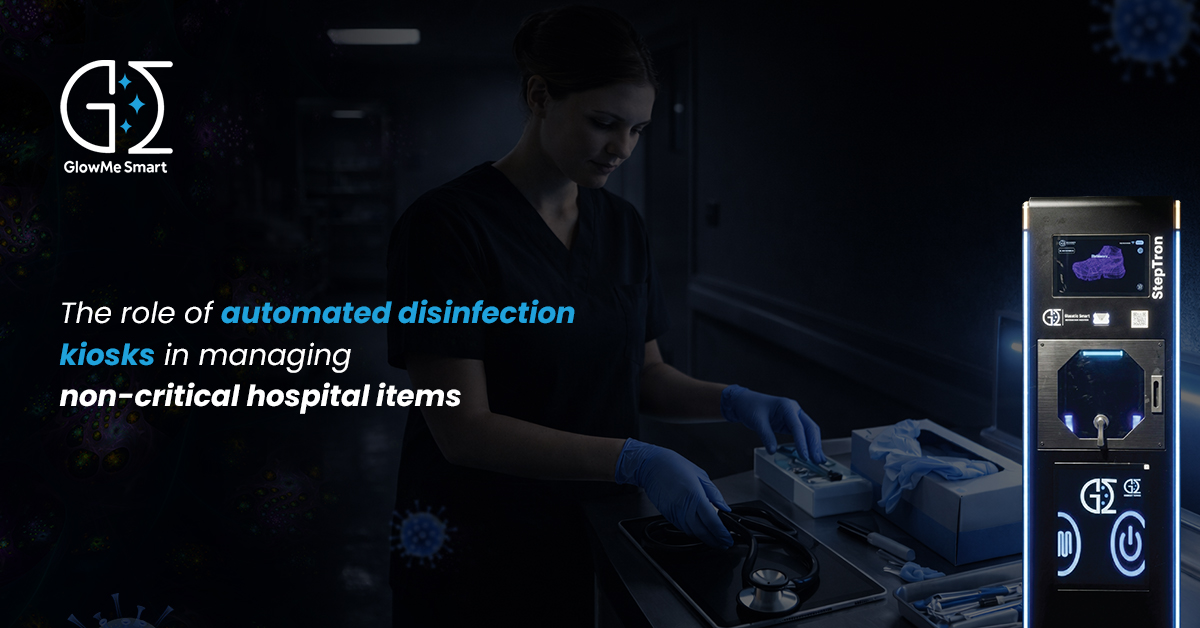
The use of automated disinfection kiosks, such as the UV-C disinfection kiosk, electromagnetic, etc., is becoming more of an innovative solution. They bring consistency, efficiency, and traceability into disinfection processes. The systems are transforming the manner in which non-critical equipment is handled in healthcare facilities. GlowMe Smart specializes in disinfection machines that can be used for hospitals and clinics.
What are Non-Critical Hospital Items?
Non-critical hospital items are medical devices, equipment, or environmental surfaces that come into contact only with intact skin (not mucous membranes) or do not directly touch the patient at all. These items pose the lowest risk of transmitting infections, but they still require cleaning and low- to intermediate-level disinfection to maintain a safe patient environment.
Why Is Cross-Contamination of Non-Critical Hospital Items Dangerous?
One of the least understood causes of HAIs (Healthcare-Associated Infections) is through cross-contamination of non-critical items. Healthcare professionals accidentally contribute to the transmission of pathogens when they transfer between patients holding contaminated devices.
This risk is aggravated by many factors:
- Frequent Handling of Devices: High-contact devices like stethoscopes, blood pressure machines, etc., have a higher risk of contamination. Especially if they are handled without proper cleaning frequently.
- Poor Hygiene: There is an inconsistency in the practice of disinfection, leading to poor hygiene and safety hazards.
- Complex Space Layout: Complex layouts and difficult-to-reach spaces make the process of cleaning them manually a hassle and incomplete at times.
- Lack of Accountability and Control: In the absence of effective tracking or surveillance systems, it is not possible to ensure consistent standards of hygiene.
In some cases, despite the awareness of the staff about hygiene protocols, due to time and pressure of work, there are still cases of failure to adhere to proper cleaning. Due to this, there is contamination despite good intentions.
What Are The Weaknesses of the Conventional Cleaning Procedures?
The traditional way of hospital disinfection solution of non-essential objects has always been manual. However, it is necessarily restricted, which reduces its practicality in the clinical setting.
- Lack of Consistency in Implementation: The different employees may be employing different cleaning strategies, and therefore getting unequal results.
- Time Constraints: Medical workers work in a hectic environment with time constraints. Hand disinfection can be a time-consuming process, and frequent disinfection can be impossible.
- Human Error: It can lead to a process of contamination of cleaning because of missed spots, insufficient contact time, or improper use of disinfectants.
- Lack of Traceability: Manual cleaning is not a good method of tracking the disinfection of an item, and when and by whom it was cleaned.
Such restrictions point to the necessity of a more reliable and standardized solution. Here’s where the GlowMe Smart disinfection machine can be a fitting solution provider.
What Are Automated Disinfection Kiosks?
Automated disinfection kiosks are closed systems that are touch-free and employ high-tech processes to disinfect objects within a short time. These kiosks are made user-friendly, and by placing any contaminated object inside the kiosks, healthcare workers can start a pre-programmed disinfection process.
The most widespread technologies are:
|
Technology |
Description | Benefits |
|
UV-C Light |
Inactivates pathogens by damaging DNA and RNA. | Fast, chemical-free, and effective against most pathogens. |
| Hydrogen Peroxide Vapor |
Fine mist penetrates surfaces and hidden crevices. |
Ensures thorough coverage in hard-to-reach areas. |
| Oxidation & Ozone | Uses chemical reactions to break down microorganisms. |
Strong action against tough, resistant pathogens. |
Table 1 demonstrates different types of disinfection systems with their benefits
How Automated Kiosks Work in Practice?
Automated disinfection kiosks are easy to use, and their operation is designed to be minimally interactive.
- Insert Dirty Item: The user needs to put the dirty object inside the kiosk. Depending upon the kiosk’s capacity, the object needs to be placed.
- Start Disinfection: The user selects a disinfection cycle, or the system automatically detects the appropriate setting.
- Safety Controls Active: There are sensors and other safety mechanisms that maintain the correct amount of exposure and avoid unintentional access to the process.
- Item Ready to Use: After the cycle has been completed, the sterilization process is complete. The item is safe to use again.
The procedure is very efficient and takes only a few minutes to complete most cycles. They are the perfect solution for non-critical item sanitization.
What Are The Key Benefits of Handling Non-Critical Items?
- Standardization of Disinfection: The possibility of standardizing disinfection procedures is one of the greatest benefits. All the items are processed in a similar validated process.
- Reduced Transmission of Infection: Pathogens on common objects can be effectively eliminated by the use of kiosks, thereby breaking the chain of infection.
- Enhanced Workflow Productivity: The automated kiosks conserve time and manpower required for cleaning the areas manually.
- Greater Compliance and Monitoring: Many kiosks are digitally tracked, and the information about their use is tracked. This will enable the hospitals to follow infection control measures.
- Safe Electronic Devices Disinfection: The automated kiosks are safe and effective as they implement a dry and non-intrusive disinfection process.
How to Integrate Automatic Disinfection Kiosks for an Infection Control System?
The use of automated disinfection kiosks does not aim at substituting current cleaning procedures but to improve them. They offer another point of protection when incorporated into a bigger infection control system.
Kiosks can be strategically located in hospitals:
- Nurse Stations: Placed at nurse stations to ensure quick and routine disinfection of frequently handled tools and equipment.
- Patient Wards: Installed in patient wards to maintain continuous hygiene for shared or mobile items.
- Intensive Care Units: Used in ICUs to support strict infection control where patients are highly vulnerable.
- Emergency Departments: Positioned in emergency departments to enable rapid disinfection during high patient turnover and urgent care situations.
This makes it user-friendly and makes staff use it frequently. It can be considered a key healthcare hygiene equipment.
Economic and Operational Impact of Automated Disinfection Kiosk
The costs of automated kiosks may prove to be worthwhile; however, the long-term gains may run higher than the investment.
- Reduced Healthcare Costs: By reducing the rate of HAIs, hospitals will be able to save costs associated with prolonged patient stays, supplementary treatments, and litigation.
- Increased Productivity: Automated processes and less manual cleaning for offices mean that the staff can concentrate on the main duties.
- Improved Patient Outcomes: Increased infection control has a direct relationship with improved patient safety and satisfaction.
Challenges and Considerations for Automated Disinfection Kiosk
Automated disinfection kiosks have their benefits, but it is associated with some challenges that healthcare facilities should overcome.
- Initial Investment: Kiosks can be rather expensive to buy and set up, especially in the case of a small healthcare facility.
- Training Requirements: The employees should be well-trained on how to make use of the kiosks.
- Limited Applicability: Kiosk-based systems do not always disinfect all items, and some equipment still requires cleaning by hand.
- Safety Measures: Some of the technologies, like UV-C light, need to be shielded and given the appropriate safety measures to avoid accidental exposure.
These issues need to be dealt with to achieve successful implementation.
Why is GlowMe Smart the right choice for an automated disinfection kiosk?
Less critical hospital equipment might not be given the same level of attention as surgical equipment. Yet, the potential role in the spread of infection cannot be overlooked. Automated disinfection kiosks are a convenient and efficient solution as healthcare systems aim to enhance patient safety and minimize HAIs.
GlowMe Smart redefines the offering by providing expert sanitization solutions with high-level disinfection kiosk machines. These systems offer a solution to the shortcomings of manual cleaning by adding the ease of use and advanced technology that ensure a high quality and consistency of disinfection.
FAQs
1. What are automated UV-C disinfection kiosks used for in hospitals?
Automated UV-C disinfection kiosks are used to disinfect non-critical items like stethoscopes, cuffs, thermometers, and handheld devices.
2. What are non-critical hospital items, and why do they need disinfection?
Non-critical hospital items are medical tools and equipment that contact intact skin; they need disinfection because they can spread pathogens between users.
3. How does UV-C light disinfection work in automated kiosks?
UV-C light works by damaging microbial DNA/RNA, preventing microorganisms from reproducing.
4. What types of disinfection technologies do automated kiosks use?
UV-C light, hydrogen peroxide vapor, and ozone or oxidation-based systems.