
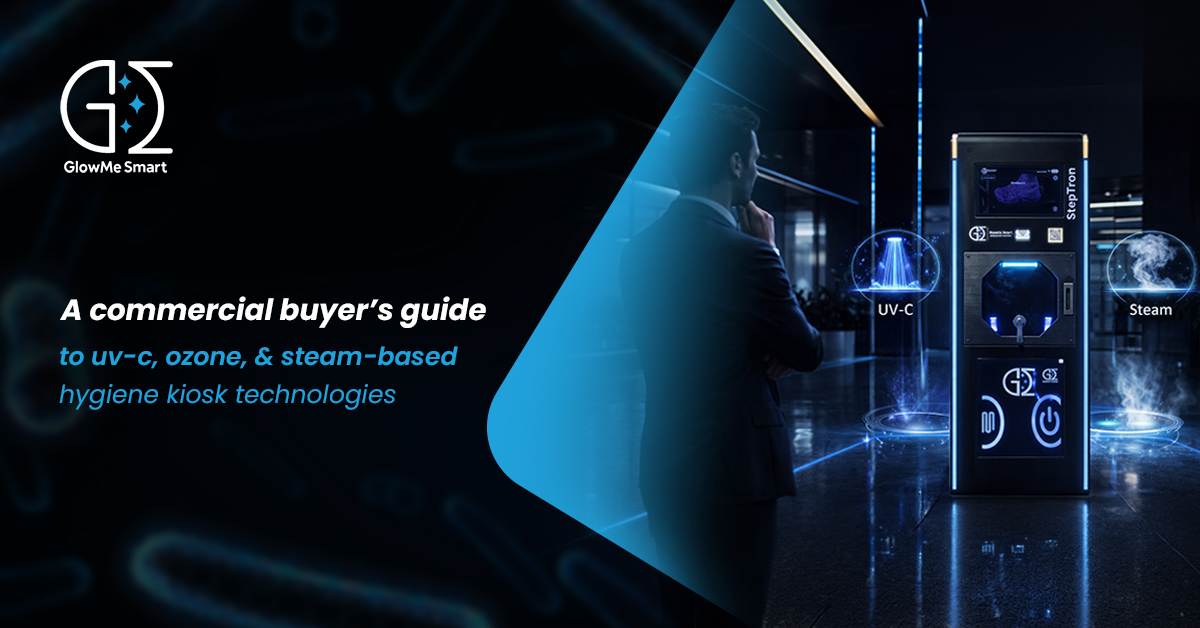
When a facility manager starts evaluating a commercial disinfection solution, the conversation quickly moves past whether to invest and straight into which technology actually works. UV-C, ozone, and steam are the three dominant disinfection methods built into hygiene kiosks today – and they are not interchangeable. Each one works through a different mechanism, delivers different outcomes across different materials and environments, and carries a different operational profile for the venue running it. Choosing the wrong one does not just mean underperformance – it can mean damaged equipment, compliance gaps, and a hygiene system that facility staff stop trusting within weeks. This blog post breaks down what each technology does, where it works best, and what commercial buyers need to weigh before committing.
What Each Technology Actually Does Inside a Hygiene Kiosk?
Before comparing performance, it helps to understand the basic mechanism each technology uses, because that mechanism determines what it can and cannot disinfect reliably.
UV-C light works by disrupting the DNA of microorganisms – bacteria, viruses, and fungi – rendering them unable to replicate. It is a photonic process, which means it requires direct line-of-sight exposure to the surface being treated. Surfaces in shadow or recessed areas receive less or no treatment in a single cycle. Well-engineered UV-C kiosks address this through reflective chamber walls and multi-angle lamp positioning.
Ozone works as a gas-phase disinfectant — it penetrates surfaces, crevices, and enclosed spaces that UV-C cannot reach by line-of-sight alone. Ozone is effective against a broad spectrum of pathogens and is particularly useful for odour elimination. The trade-off is containment: ozone at disinfecting concentrations is harmful if inhaled, so any kiosk using ozone must seal the chamber completely during the cycle and ventilate thoroughly before opening.
Steam uses heat and moisture to kill pathogens through thermal destruction. It is highly effective on porous and fabric-based materials — penetrating fibres that UV-C cannot reach and avoiding the chemical residue concerns associated with some ozone applications. The practical limitations are drying time and material compatibility: steam-treated items need time to dry before use, and some materials — leather, certain electronics — cannot tolerate repeated exposure to wet heat.
UV-C Technology: Where It Excels and Where Its Limits Show?
UV-C is the most widely deployed technology in commercial hygiene kiosks, and for good reason. It is fast, dry, chemical-free, and produces no residue on treated items. For helmets, shoes, and personal belongings processed at high volume across a commercial entrance, UV-C delivers a consistent disinfection cycle that does not damage surfaces, does not require drying time, and can be automated end-to-end without staff involvement.
The environments where UV-C kiosks perform best are those combining high throughput with material variety – a gym sanitising machine handling dozens of helmets and pairs of shoes per hour needs a technology that works quickly and without requiring any preparation of the item being treated. UV-C delivers exactly that.
The case for UV-C in high-footfall commercial venues:
- No drying time required: Items come out dry and ready for immediate use — critical at gym, hospital, and fleet entry points where throughput cannot slow.
- No chemical residue: UV-C leaves no surface contamination, making it suitable for food-adjacent environments, healthcare settings, and direct-contact items.
- Fully automatable cycle: UV-C kiosks can run without any staff intervention from insertion to completion, removing the human variable from the disinfection process entirely.
- Material compatibility: UV-C does not degrade leather, synthetic fibres, rubber, or electronics in the way heat or moisture-based methods can over time.
- Logged operation: Every UV-C cycle can be recorded with a timestamp and duration, providing auditable hygiene data for compliance and accreditation requirements.
Ozone Technology: The Case for Gas-Phase Disinfection in Enclosed Commercial Spaces
Ozone is the technology of choice when penetration depth matters — when the item being disinfected has recessed surfaces, internal cavities, or porous materials that UV-C light cannot reach with consistent intensity. It is also the superior choice for odour elimination at the molecular level, which is why venues with persistent odour management challenges reach for ozone-capable units.
A fitness hygiene station positioned at a locker room entrance, for example, is dealing not just with pathogen load on shoe soles and equipment surfaces but with embedded odour in fabric and foam padding. UV-C alone addresses the surface pathogen but leaves the odour intact. Ozone treats both simultaneously, which is why it appears as a secondary or combined technology in units designed for sports and gym environments specifically.
The operational requirements for ozone at a commercial scale are strict, and buyers should evaluate them carefully:
- Chamber sealing is non-negotiable: Ozone at disinfecting concentrations cannot be released into occupied spaces. Any unit using ozone must demonstrate complete chamber isolation during the cycle.
- Post-cycle ventilation time: Ozone dissipates to safe levels, but this takes time — typically two to five minutes post-cycle, depending on chamber volume and ventilation design. This affects throughput calculations at high-footfall entries.
- Odour elimination as a measurable outcome: For gyms, sports clubs, and fleet operators dealing with persistent footwear and equipment odour, ozone delivers results that UV-C alone cannot match.
- Regulatory compliance: Ozone-generating equipment may be subject to workplace safety regulations in certain Indian commercial environments — procurement teams should verify requirements for their specific venue type.
Steam Technology: When Thermal Disinfection Is the Right Call for Your Venue?
Steam is the oldest of the three technologies and the most intuitive — heat kills pathogens, and most people understand that instinctively. In a commercial hygiene kiosk context, steam is most relevant for fabric-heavy items, dense foam materials, and items that need both disinfection and deep-clean penetration that neither UV-C nor ozone can fully achieve.
The material compatibility constraint is the primary evaluation point for steam. Facilities processing primarily synthetic rubber, hard plastic, and coated surfaces — the typical profile of a shoe deodorising kiosk at a petrol station or delivery fleet hub — will find steam less practical than UV-C or ozone. The drying requirement adds cycle time, and repeated wet-heat exposure degrades certain sole bonding adhesives and synthetic uppers over time.
Where steam genuinely earns its place is in hospital and clinical environments processing fabric-based protective equipment, or in hospitality settings where soft furnishing items need both disinfection and deodorising treatment. In those specific use cases, thermal penetration delivers outcomes that the other two technologies cannot replicate without chemical assistance.
How to Match Technology to Your Venue Type: A Practical Decision Framework?
The technology decision is not a universal one — it is venue-specific. The same commercial premises can have different requirements at different entry points, which is why the most operationally effective hygiene infrastructure often combines technologies rather than standardising on one.
Match your venue profile to the right technology combination:
- Gyms and sports clubs: UV-C for helmets and hard-surface equipment at speed; ozone for footwear and fabric items where odour is a documented facility management problem. A combined unit that handles both in sequence delivers the most complete outcome.
- Hospitals and clinical facilities: UV-C for high-throughput personal item disinfection with full cycle logging; steam for fabric PPE and soft protective gear processed in lower volumes. Logged data from UV-C cycles supports accreditation requirements directly.
- Hotels and guest houses: UV-C for visible, premium entry hygiene infrastructure — fast, dry, and guest-facing without any chemical or odour concern. Steam as a supplementary solution for housekeeping-side applications.
- Petrol stations and fleet hubs: UV-C combined with ozone for footwear processing — the UV-C handles pathogen load while ozone addresses the odour compounds embedded in work boots and delivery footwear.
- Corporate offices and co-working spaces: UV-C at primary lobby entry provides a visible hygiene standard that is fast, silent, and operationally unobtrusive — no ventilation requirement, no consumable management.
Operational Questions That Matter More Than the Technology Spec Sheet
Technology selection is only part of the procurement decision. The operational profile of the unit — how it runs day-to-day, what it requires from facility staff, and how it performs under real commercial volume — is where most buyers find the gaps between specification and reality.
Before signing off on any hygiene kiosk procurement, facility managers should be asking:
- What is the rated throughput per hour, and does it match peak footfall? A unit that creates a queue at the entry during the morning rush stops being used within weeks. Throughput spec must be evaluated against actual peak-hour visitor data, not average daily volume.
- What consumables does it require and how often? UV-C lamps have a defined lifespan and need replacement on a schedule. Ozone generators require maintenance cycles. Steam kiosks need water supply management. The consumable cost and frequency directly affect the total cost of ownership.
- How is cycle data logged and reported? For venues operating under hygiene compliance requirements or quality accreditations, the logging capability of the unit is not a bonus feature — it is a procurement requirement.
- What is the service and support infrastructure? A hygiene kiosk that fails at a hospital entrance or a high-footfall gym entry during peak hours is an operational incident. Local service capability and response time should be part of the vendor evaluation, not an afterthought.
- Does it integrate with the existing entry layout? A unit that requires structural changes to the entrance, a dedicated power installation, or disrupts visitor flow creates an implementation cost that rarely appears in the initial quote.
Worth the Investment? GlowMe Smart and the Technology Choices Built for India’s Commercial Realities
The technology debate — UV-C versus ozone versus steam — resolves itself once you are clear on the specific contamination problem you are solving and the operational environment it needs to solve it in. What does not resolve itself is the cost of getting it wrong: a mismatched unit that underperforms, requires more staff management than anticipated, or fails to handle actual footfall volume becomes a facilities liability rather than a hygiene asset.
GlowMe Smart has built its product range — including the StepTron shoe disinfection kiosk, the HelmetTron, and the DiaryTron — around UV-C and ozone technology combinations validated for India’s specific commercial entry environments. Every unit is engineered for the volume, material variety, and operational demands of real high-footfall venues — not laboratory conditions.
The result is a hygiene kiosk that does not require a facilities team to manage it, does not create a bottleneck at the entry, and delivers the same disinfection result for the hundredth visitor of the day as it does for the first. That consistency — across technology, across volume, and across time — is what makes the investment case straightforward for any venue serious about entry hygiene.
Reach GlowMe Smart now and find the right hygiene kiosk technology for your specific commercial entry environment — built to work from day one.
FAQs
1. What is a hygiene kiosk, and how does it work?
A hygiene kiosk is a machine that disinfects items like shoes, helmets, or personal belongings using UV-C, ozone, or steam. It runs an automated cycle to eliminate bacteria, viruses, and odours before items enter a facility.
2. Which is better: UV-C, ozone, or steam disinfection?
There is no single best option—each works differently based on the use case and material type. UV-C is fast and dry, ozone removes odours deeply, and steam is best for fabric-based items.
3. Where is UV-C disinfection most effective?
UV-C works best on exposed surfaces where light can directly reach and disinfect quickly. It is ideal for high-footfall areas like gyms, offices, and hospitals needing fast turnaround.
4. Is ozone disinfection safe for commercial use?
Yes, ozone is safe when used in sealed kiosks with proper ventilation after each cycle. It is highly effective for odour removal and deep disinfection in enclosed items.
5. When should businesses choose steam-based hygiene kiosks?
Steam is best for fabric, foam, and porous materials needing deep thermal cleaning. It is commonly used in hospitals and hospitality, where thorough penetration is required.
6. Do hygiene kiosks require regular maintenance?
Yes, each technology has maintenance needs like UV-C lamp replacement or ozone system checks. Regular servicing ensures consistent performance and long-term reliability.